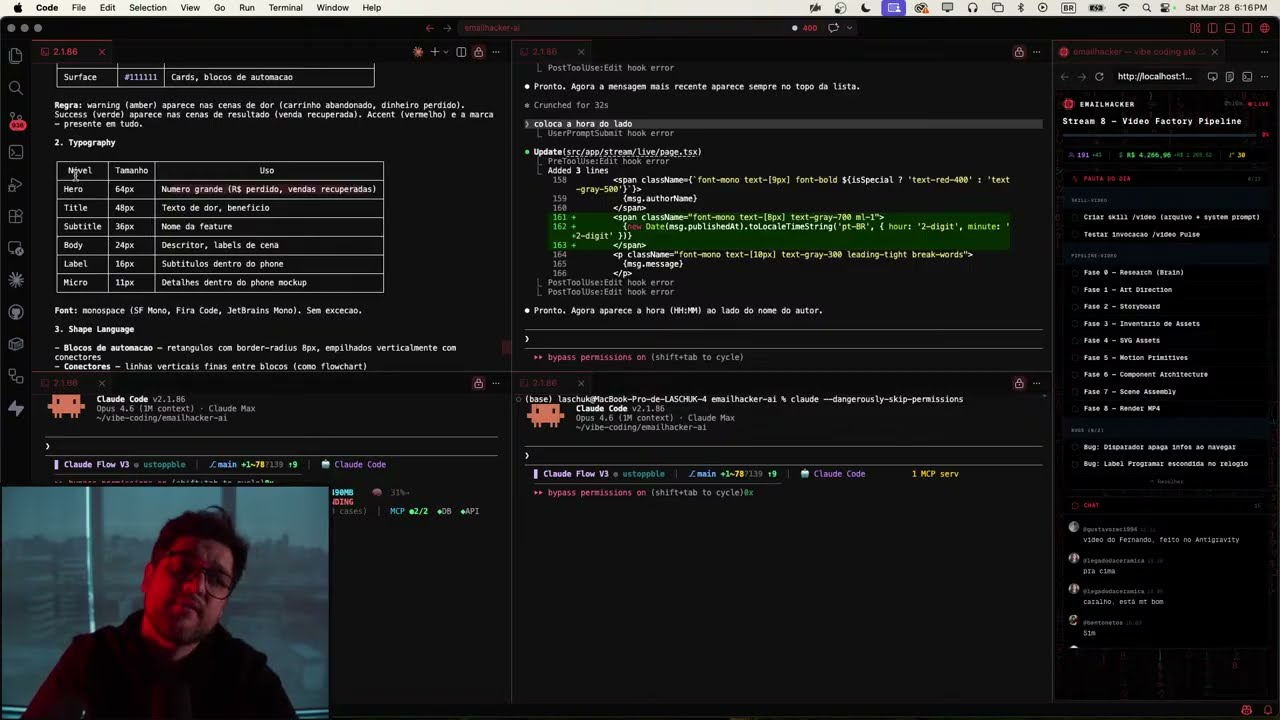
On the eighth day of the journey, Guilherme tackles a problem that had been nagging since the previous stream: the AI-generated promo videos came out visually inconsistent, "a guess" every attempt. The fix was to design, live, a ten-phase pipeline inside Cloud Flow — brief, art direction, storyboard, asset inventory, SVG generation, motion principles, Remotion component architecture, assembly, render, and a repeat for shorts — so every new video would reuse icons, palette, and typography already approved instead of starting from zero every run.
The first test ran on his own product, Mail Hacker AI (the vertical email marketing agent he sells to info-product sellers), generating a video about the sales-recovery funnel with music and sound effects — visibly more polished than the previous day's version. Trying to generalize the process into a "wizard" where any user would just paste their own site's URL, brand extraction via Firecrawl failed (it picked up the wrong colors and ignored the test site's design system), and mid-fix, API keys for Firecrawl and Anthropic from the real project ended up exposed on screen — forcing him to pause the explanation and rotate the credentials live.
After the scare, the stream turned into a stress lab: swarms of four, then six, then five agents running in parallel to generate several videos at once, testing how far Cloud Flow could handle simultaneous execution. To close with a looser (and more revealing) test of the tool's potential, he asked for a summary of the John Wick story, which came out first in typographic mode, then got an animated shootout scene in silhouette style, was redone in 3D at chat's request, and finally got AI-generated narration synced to the video.
The stream ended without the promised public wizard — he decided to turn the flow into an MCP before releasing it to the community — but with validation that the ten-phase pipeline solves the visual-consistency problem that motivated the whole day. Along the way, a paid-traffic campaign for Mail Hacker AI also went live, and it closed with R$4,266.96 in email marketing revenue, reinforcing live the project's central thesis: a vertical AI agent isn't a SaaS, it's the team itself operating alone.